I am launching an initiative to unite Workplace Humanitarians. I am gathering people to join me on my journey of humanizing the workplace, via Scrum or otherwise. I am calling this platform the “Center for Humane Work Organization”. I have decided to do so via Patreon so I can maintain my independence while having the resources and means to continue my (non-billable) creative work, contribute in a positive way to the world and feed my family. It’s a win-win-win situation.
Although my professional life has revolved around Scrum a lot, the aspiration that drives me in the first place is: to create a better world to live and work in.
I therefore call myself not just an independent (Scrum) Caretaker but also a “Workplace Humanitarian”. This is not a standard, formal role (yet, but…who knows). Rather, it is a label that reflects how I deliberately work towards making workplaces more humane and dignified. This is also expressed when I state that I am on a (never-ending) mission to humanize the workplace. I help others develop more humane ways of working, not merely more efficient ones. However, as engaged people care about outcomes anyhow (without needing to be instructed to do so) a more humane workplace is a more productive one too. In my role I am guided by principles like humanity, neutrality, impartiality and independence. I advocate for structures and practices that give people autonomy, voice and protection. I focus on nurturing people‑centric, value‑driven ways of working in which ‘productivity’ is aligned with ‘humanity’. In that sense, “Workplace Humanitarian” is a self‑chosen identity that highlights a moral stance too: to influence and enhance the working conditions for the longer term so that people suffer less and flourish more while they earn a living and their organizations prosper.
My new whitepaper “Scrum. Not Scrum. (Redefining the Future Through the Roots)” is now available. I derived the content from the new book I am writing. That new book will hold my vision on how to deeply and systemically redesign organizations towards a more humane system based on a new development paradigm in which ‘productivity’ is about value and is aligned with ‘humanity’. Revisiting the roots of what is called “Scrum” showed me the path to shaping the future of development as part of a better world to live and work in.
In December (2025) I started working on a new book. Again. And at the same time…finally. Over the years I have gone through several attempts to write a new book, but they all ended up in the bin. This time was different. Maybe it was some inner drive that made it feel different?
In 2019 I shared my observations about what I called The Illusion of Agility in a short movie and in a whitepaper. They hold my observations on what I had seen happening with most—if not all—so-called ‘Agile Transformations’ or similar attempts of organizations to become Agile by adopting Scrum or otherwise. Because pointing out the problem (“inspection”) without offering a way out (“adaptation”) is hardly helpful, at the same time I also shared my advice to “Re-imagine your Scrum” in a short movie. However, I never got to writing the full whitepaper until the fall of 2025. Finally publishing this whitepaper really was the spark I needed to get going on a new book.
The plan was to elaborate on the ideas of “Re-imagining (your) Scrum”, expand and enrich it with ideas of “Moving (your) Scrum Downfield” and add a chapter on why and how to “Humanize the Workplace”. These are the topics of most of my speaking engagements since 2020.
Over the past few years I have created three proprietary workshops that I call “Scrum Focus Classes“:
“The Scrum Values” is a workshop about Psychological Safety. In it we collaboratively explore how Scrum’s five core values help look beyond the rules of Scrum and establish psychological safety in a team. Because Scrum is a framework of rules, principles and…values. And values drive behavior. Ultimately, Scrum is more about behavior than it is about process.
“Engaging the Brain” is a workshop about Psychological Safety. In it we collaboratively explore what the social neuroscience says about motivating and engaging people in the interaction game of navigating complex challenges. Although adopting Scrum will not magically restore fun and work happiness, it does hold some keys to the doors that unlock intrinsic motivation.
“Multi-team Scrum” is a workshop about Scrum in the Large. In it we collaboratively explore how even when working with multiple teams it is possible to keep the rules of the game intact. It helps people and organizations identify their ‘product’ and re-think their Scrum to upgrade their organization accordingly. Ultimately, the rules are independent of the scale at which Scrum is organized.
The Scrum Focus Classes offer unique and specific modular learning opportunities These interactive workshops allow me to engage, collaborate and interact with friends of Scrum across the planet and help them move (their) Scrum forward.
The Scrum Focus Classes complement my Professional Scrum offering that consists of the facilitation of following 2-day Scrum.org courses:
1/ De onverwachte weg naar een onverwachte kennismaking
Van de technische wereld…
Januari 1996. Ik ben het beu. Alles. Ik verdien niet genoeg. Ik krijg niet de werkmiddelen die ik meen nodig te hebben (lees: dure software). Ik krijg geen firmawagen. Terwijl mijn privé-wagen eigenlijk van betere kwaliteit is dan de firma-exemplaren. Ik zoek maar vind geen nieuwe betrekking. Waarom word ik zelfs niet uitgenodigd? Ik brand. Terwijl instant antwoorden, oplossingen of uitwegen uitblijven, brand ik harder. Maar ik brand niet op. Ik wil vooruit. Ik wil meer. Ik wil alles. En eigenlijk wil ik het nu.
Kortom, bij de aanvang van 1996 ben ik een en al ongeduld en als gevolg daarvan een en al frustratie en irritatie. Eigenlijk was ik echt wel een héél grote brok frustratie. Ik ben sinds mei 1993 in dienst bij deze KMO (‘Kleine of Middelgrote Onderneming’–met in dit geval de nadruk op de ‘K’ gezien de 8 personeelsleden en de 2 eigenaar-oprichters) na een tweede sollicitatie. Ik herinner me nog mijn eerste sollicitatie bij het bedrijf, in de zomer van 1992, als vers afgestudeerd ingenieur elektronica (met specialisatie hardware engineering). Ik herinner me nog hoe ik compleet door de mand viel na een vraag over een RS485-driver. Ik leerde later (en prentte dat zo in mijn geheugen) dat het bedrijf die gebruikte voor seriële, stroomgestuurde communicatie. Wat bleek? Als industrieel ingenieur werd je verondersteld niet enkel iets (technisch) te kennen, maar ook iets (technisch) te kunnen. Daar sta ik dan met mijn glinsterend diploma en de veronderstelling in aanmerking te komen voor leidinggevende functies—falend in elk opzicht: in kennis, kunde en aspiratie. Na mijn tweede sollicitatie bij het bedrijf, in mei 1993, was de positieve commentaar dat ik niet enkel werkervaring had opgedaan, maar dat ik ook behoorlijk wat aan maturiteit had gewonnen. Van september 1992 tot maart 1993 had ik als software-ingenieur op VAX (en een beetje op OS/2) gewerkt met wat buitenlandse verplaatsingen voor een gigantisch project voor magazijnautomatisering in Ierland (vaak als enige vertegenwoordiger van het bedrijf). Deze keer kreeg ik wel een plekje aangeboden.
Following is an article from my latest newsletter, “The Scrum Caretaker Courier 13“. Subscribe here if you prefer receiving my news and updates directly.
Over the years I have often observed with amazement what happens on so-called ‘Social Media’: what is being shared by whom (for what reason) and how others respond to what is being shared by whom (for what reason), whether it concerns a statement, a picture, a snippet, an event or an occurrence within the closed so-called Social Media environment or in what is usually called society or the (outside) world. Yet, for about 15 years it never stopped me from spending quite some time on those so-called Social Media platforms—checking out what was happening and occasionally attempting to contribute. It did take a long time but finally I seem to have realized that it was probably more like a habit rather than being a valuable activity. Realizing that I wasn’t getting a lot of personal benefits or insights from the time spent on these so-called Social Media, at first (a few years ago) I started limiting my presence on these platforms to professional topics only.
But even that didn’t work out in the long run.
And thus, toward the end of 2023, I stopped actively using Facebook, Instagram and Twitter/X—instantly. I strongly felt that these platforms had become and would remain mostly non-collaborative, non-informative and even plainly toxic environments. Those platforms have too many inhabitants (depending upon their daily mood swing) neurotically complaining about, moaning over, bashing or belittling other inhabitants and events whether within or outside of that closed virtual world. I don’t exclude this perception to be influenced by my introvert nature.
In the spring of 2016 I started calling myself a “Scrum Caretaker”. I had to come up with a job title after leaving behind my positions with the more traditional sounding titles of Partner of Ken Schwaber and Director of the Professional Scrum Series at Scrum.org (2013-2016) and of Global Scrum Leader and Principal Consultant at Capgemini (2010-2013). And, for that matter, all titles and positions I’ve held throughout my lifelong professional journey (1992-2010).
In that spring of 2016, as I renamed my one-person company to “Ullizee-Inc” (what I like to call my ‘business vehicle’ to bring my Scrum Services to the market), I started calling myself a “Scrum Caretaker”. Every other, more traditional sounding title felt silly, because, after all, my company was (and still is) just…me (one person, literally).
Some time later I added “independent” to my self-chosen title of “Scrum Caretaker” to emphasize that I am not a part of any fixed corporate structure with hidden commercial liabilities or intentions (after all, there is a reason why I never created some custom ‘framework’ and related certification scheme). In a next step I expanded “an independent Scrum Caretaker” with my mission “on a journey of humanizing the workplace with Scrum”.
Let there be no misunderstanding: money is important.
Money is important for our family. My wife is my stability (1993). We have three kids (2001, 2003, 2013) of which the two oldest (sons) have a disability (Duchenne and Down Syndrome). My family is my stability. Throughout the years we lost people (some dear, some not). We cope. We gained liberty. Money is important because it pays our bills. As a family, we need and use money to keep us fed, pay off our mortgage, buy stuff and lead a materially somewhat comfortable life. My work as an independent Scrum Caretaker via my one-person company Ullizee-Inc is the sole source of money for our family. We have no backup or additional sources of income. Scrum is what I do for a living. Scrum is what I’ve been practicing for the past 20+ years.
Beyond the fact that not even all my Scrum Caretakery work is paid work or even about money, I can’t escape giving up financially more beneficial Scrum Caretakery activities to spend a substantial proportion of my time on (what I call) my Home Caretakery activities. I am inescapably needed at home a lot of the time to provide our (adult) sons with the specific care they need as a result of their respective disabilities. There is no other way given the physical nature of that care. There is no other way given the absence of a network around us and given the lack of the funding that would be needed to purchase professional care that would be sufficiently tuned to their needs.
Still, I am unable to blindly go after money only, not even in situations where it might be justified. Regardless of ethics, values, principles or purpose, it is also a conscious choice to take my Home Caretakery and being with my family seriously, and to some extent I wouldn’t want it otherwise. Money is important, but it is not what drives us.
Money was not what drove my wife and I when I gave up my position as software engineer and aspiring project manager in favor of running a bookshop (1996). It wasn’t when I refused the position of CIO at Belgium’s first e-com (2001). It wasn’t when we gave up on my wife’s income to allow her to develop her creative talents (2007). It wasn’t when I abandoned a position of Principal Consultant and a future higher-up the ladder function at a large international consulting company (2013). It wasn’t when we bought a house we didn’t think we could afford because of the increasing wheelchair-dependence of our son (2014). It wasn’t when I decided to go completely independent with my one-person company Ullizee-Inc (2016) and not be part of any fixed structure for the time being (which is to this date).
It took me a very long time, nearly a life time, to even start realizing what it is then that drives me, if not money. I still find it difficult to put words to what that is and articulate it with some precision. Ultimately, it boils down to people and working with people, treating people as human beings and not accepting otherwise. It leads to my personal mission of promoting and establishing more humane working environments and humanizing the workplace in an attempt to reduce toxic and abusive behaviors and restore people’s engagement (at work). Humanizing the workplace equals undoing the past mechanization of the workplace (during the dominance of the industrial paradigm), while helping leadership and anyone involved see and understand that workplace humanization equals company deworrification. Because, ultimately, engaged people care more (about team, customer and company outcomes of their work).
It took me even longer (another life time?) to understand where this drive comes from, what its roots are, unveil the why of why I’m doing what I do, why I can’t let go, why I often behave in the way that I do, take the decisions that I take–often intuitively, fiercely and stubbornly, regardless of the financial consequences. I have gradually discovered that it is most likely an attempt to turn the traumas of my childhood and my youth into a mission. I guess I needed to take the pain of my youth and transform it into a mission. The result is a mission and a life of serving others to break (not continue or start anew) a circle of emotional violence and mental abuse, to turn a downward spiral around and make it go upward. The roots of my mission is what I call my Past Continuous Sorrow. It is a sort of sorrow that nobody recognizes, notices or sees. While every day I am reminded of this hole that cannot be filled. But I find comfort in my lack of importance in the fact that in 4-5 billion years our dear sun, before disappearing after a life expected to take 9-10 billion years, will swallow us whole anyhow, as a sign of tenderness.
I believe that these specifics of my past are why I engage and want to have an impact, make a difference and help create a better world. I believe it is why I’m completely insensitive to anything Career, Hierarchy, Title, Position, Role, Power, Fame (etc.). These big capital words are not what drive me. They are no goals to me. And more than just being insensitive to them, I’ve even found that it typically turns out rather counterproductive if people ‘use’ it to ‘motivate’ me, and even more when connecting money to it. It is the only explanation for my past, instinctive anti-responses in situations where that was essentially what was happening. Money is important, but it is not what drives me. Money is important, but integrity is more important. Every time I left a company was essentially because of integrity. Integrity is why I ended up this one-person company aspiring to change the world for the better. Doing this in all independence is made even more difficult by not being acknowledged for the work I’ve done as part of company structures in the past and the legacy I tried to leave in favor of Scrum and humanizing the workplace.
But if it was money that drives me, I would never have had the time to become what I didn’t know I wanted to be. And although it may look as if there was a plan, there wasn’t. If it was money that drives me, I would have created my own proprietary program of Agile/Scrum classes and a certification scheme when I went independent (which seems to be what many people thought I was going to do). If it was money that drives me, I would have created my own proprietary Agile scaling model (without calling it a model, obviously) and set up even more classes and extend my certification schemes. If it was money that drives me, I could have created my own proprietary development framework (ending up with yet another Scrum derivative) as a foundation for even newer courses and more certifications and an even larger ‘model’ to scale it. If it was money that drives me, I would be giving mass production trainings for people not interested in learning, but in quickly certifying. If it was money that drives me, I would do individual coaching of people not interested in experience, but still wanting level III certifications. If it was money that drives me, I wouldn’t spend time on writing. If it was money that drives me, I would be out there in the market to shamelessly, vigilantly, relentlessly and ruthlessly market, promote, sell, oversell and resell my 20+ years of experience (like a real consultant would do) while pushing competitors out of the market rather than spending time at home taking care of our sons and exploring give-and-take collaborative partnerships (even when largely unsuccessfully). If it was money that drives me, I would be speaking at events only when offered large sums of money with no other intent than entertainment and self-promotion.
Rather, after abandoning several (financially more rewarding) positions and titles, once upon a time I started calling myself a Scrum Caretaker (2016). In the expanded version that became an independent Scrum Caretaker to leave no doubts that I am not a part of any fixed structure, big nor small (2017). I added my personal mission to it: an independent Scrum Caretaker on a journey of humanizing the workplace with Scrum (2019). I’ve noticed how the term “Scrum Caretaker” resonates with people across the planet. Maybe more Scrum Caretakers will emerge. Maybe some day we will form a Scrum Caretakers Collective.
Maybe it will happen once enough people start realizing that the time has come to restore the balance between the ‘people’ aspect of Scrum (“Self-organization”) and the ‘process’ aspect of Scrum (“Empiricism”). Because the focus of many Scrum adoptions is still tilted heavily towards the process aspect, and not barely enough on the people aspect. Scrum is too much limited to a way to create and deliver product; more features, sooner, faster. The added value of adopting Scrum for the people doing the work is conveniently ignored. But, guess what, people who are truly engaged and motivated will build better products. Ultimately, using Scrum as a tool to humanize the workplace is the way forward.
Let there be no misunderstanding: money is important.
Unfortunately, too many people and enterprises take it for granted that it is not money that drives me (not willing to pay, to not return a favor, to not grant me a piece of the cake, but some bread crumbs only). So, in case of doubt: although money is not what drives me, I am trying to make a living out of my mission too, not in the least to support my family but also to fund my ways of offering inspiration that are beyond money. The alternative is charity and a hungry family. A good start, and thus one of my ambitions as from 2024 is to speak for free less. I know you now understand.
People regularly approach me (often privately) with the request to speak out (potentially publicly) on various things ‘Agile’. Although I am humbled by the trust that genuinely speaks from their words, there is also (o, the horror!) the expectations in their requests.
I want to share my (multi-layered) doubts and hesitance regarding the matter of speaking out publicly on (some) things ‘Agile’. And thereby, in a way, speak out publicly anyhow… albeit offering–what I hope is–a nuanced perspective.
1. Regarding the matter of importance and impact
I wouldn’t overrate the importance or impact of my words and viewpoints. Because, surprise, surprise, I am no wizard. Agile nor Scrum. I’ve only found a way to stick around for a long time and still be hopeful. It is an ‘achievement’ that also includes that I have survived a bunch of ups and downs and have seen many others come and go.
The fact that some of my public messages get a lot of ‘likes’ is to a certain extent meaningless. It is not a sign of importance (let alone of impact). Because pressing ‘like’ on some social media platform does not represent commitment or action. I have found over and over that it often doesn’t even mean that a liker has actually read what I’m sharing. Worse, I observe regularly how some of the comments seem to have no other aim than trying to shine a light of importance on the commenting subject, often through some form of simplistic clickbait message. One of my core beliefs is that a name and a reputation can at most be a side effect, never the purpose (unless one doesn’t mind a very poor purpose).
Judging by the number of people actually actively joining me in my journey of humanizing the workplace with Scrum(extremely low), much of the expressed ‘respect’ is no more than paying lip service. Best case it is a confirmation of my wrongly presumed importance. It is not a confirmation of any impact that I may have (or not). Commitment is not in what people say, not in how they name themselves or look like. It is in what they do.
Nor can there thus be much expectations (in a positive or negative sense) of the actual impact of my words or viewpoints regarding the question whether a process or framework (whatever name they chose for themselves) is “Agile”.
2. Regarding the matter of action and contribution
Another highly personal belief is the belief in positive action. I want to deliver a positive contribution to our world, help increase the global levels of positivity. Believe me, I have little idea where that drive comes from. As I am aging however, the finding keeps taking root more firmly that I am a man who took the pain of his youth and transformed it into a mission.
There are already so many haters and bashers, certainly regarding my favourite tool, Scrum. So much energy is wasted on spreading negativity. Some people seem to spend their entire life on nothing but ranting. It might help them gain many followers and leave them with a feeling of being a ‘leader’ (again, what a strange idea of purpose). Whether it is through some form of simplistic clickbait messages or otherwise, helpful it is not. Giving them more attention is unlikely to help either. Unless increasing their feeling of importance is the goal. Not to mention that I have found that it often completely drains me, which, I realize, is just one of my many shortcomings for which nobody else is to be blamed.
So, I feel comfortable enough to ‘speak out’ by liking, sharing or commenting on certain messages as a sign of my support. In my case, it is generally a well-considered choice, as is not liking messages. (On a side note, this also applies on the many requests by authors I get to read their article) It is similarly a well-considered choice not to spend time on correcting, judging or contradicting messages, not even when I think I could. I don’t overrate my ability to make people listen, let alone change their mind.
Furthermore and finally, I simply have too many plans, hopes, dreams and ambitions to allow such a waste of time to creep in. Life’s too short.
3. Regarding the question whether a process or framework (whatever name they chose for themselves) is “Agile”
Regardless whether free-floating opportunists like it or not, there is no denying that the source and roots of all things ‘Agile’ is the “Manifesto for Agile Software Development”, or the “Agile Manifesto” in short. Whatever gets labeled as “Agile” should by default mean that it is in line with the four value statements and twelve principles of that Manifesto. It is only fair to use that alignment to assess the validity of the claim of the label “Agile”. And although those value statements and principles were expressed in the realm of software development, they are sufficiently generic to be interpreted outside of software development.
In my book “Scrum – A Pocket Guide” I repeat that “Agile” is not one fixed process, method or practice. In the absence of a concise, specific definition of “the Agile process”, I list and describe three characteristics as the core traits that are common and typical to an Agile way of working:
People-centric.
Iterative-incremental progress.
Value as the measure of success.
I also describe “agility” as the (organizational) state envisioned by moving to an Agile way of working: a state of continuous flux, high responsiveness, speed and adaptiveness. It is a state needed to deal with the unpredictability so common to most of today’s work and to the moving markets that organizations operate within. I consciously capitalise “Agile” but not “agility”.
SAFe, like a few other methods, can be many things (helpful or not, who knows) but it is neither Agile, nor is it a framework. SAFe is exactly the sort of process (in the sense of ‘methodology’) as referred to by the signatories of the Agile Manifesto in the first Agile value statement (“INDIVIDUALS and INTERACTIONS over processes and tools”). SAFe turns this statement upside down and reverses the expressed preference, as it does to the 3rd and 4th Agile value statement (and likely even the 2nd). Similar findings can be made about the lack of various aspects of “Agile” highlighted in the twelve principles, like timescales, collaboration, emergence and self-organization. After all, there is a reason why there were no people from RUP invited for the Snowbird gathering.
My hesitance to speak out loudly is not because of my ‘reputation’ (I have none) or commercial or legal consequences. It is because I know first-hand that the best form of promotion that SAFe got in the past was a few global leaders heavily speaking out against it. What they said was correct, well-intended and of high integrity. Still, the effect was people massively looking at SAFe, thereby causing damage and big setbacks in helping the world move away from the paradigm of industrial views and beliefs.
It shows how the statement of my book is true: the old (industrial, Taylorist) paradigm has deep roots and a considerable half-life time. So, let’s hope nobody reads this text if it increases even more interest in a methodology that claims you can change without having to change. And I’ve already spent too much valuable time on it anyhow.
By the way, various other approaches claiming to be “Agile” don’t put people (as human beings) and capitalizing on people’s intelligence and creativity front and center either. Nor are they iterative-incremental. Work is not organized in short cycles allowing and provoking emergence, pivoting and bottom-up knowledge creation. They also aim at pressuring for ‘more’ (volume) instead of discovering ‘better’ (value). They can be useful or helpful (who knows), but they are not “Agile”.
And for the bashers/trolls, I am well aware that many implementations of Scrum suffer from the same problem. At least, it is a problem of interpretation, not of definition. I stand my ground when stating that "Scrum is the most widely adopted definition of Agile".
I don’t abide by it, but the reality is that many, many people don’t care about integrity but prefer (commercial) convenience.
A last, personal example: As part of my ambition and will to deliver a positive contribution, I have developed a Scrum Pocket Class called “Scrum in the Large”. It is based upon the insights on ‘scale’ that I already shared in the first edition of my book, in 2013, which was even before (or maybe at the start of) the whole scaling hype. As most of my public classes, it barely attracts people (it is not what most want to hear), although the people that join generally describe it as a true eye-opener. I accept it as a confirmation of what I stated regarding the matter of importance and impact: my limited impact or recognition rather than being an “important voice” or “Scrumfluencer” (quoting some direct messages).
I’m at peace with that. It’s even good to keep my feet on the ground while being able to sustain my family and do my part of personal caretakery at home. At most, I am a man who took the pain of his youth and transformed it into a mission. It’s an infinite game anyhow. I plant seeds.
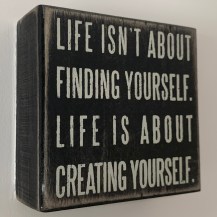
“Life isn’t about finding yourself. Life is about creating yourself.“
George Bernard Shaw
Dear reader
If you happen to have attended one of the many online events I have been in last year, you know how important the above quote is for me.
It feels like the past twelve months, more than just about creating myself, my life was mostly about re-inventing myself. Often and repeatedly. Do you feel that way too?
Besides forcing my family and me in a semi-continuous lockdown situation, the past Covid-year has made me professionally go down paths that I never intended, planned or aspired to go down. No matter how annoying that was at times and no matter how it really was not what I wanted to do, I also started realizing that I have should done many of these things many years ago. Do you recognize that too? In my case, it largely boiled down to further increasing my independence as a Scrum Caretaker. Not the easiest position, but still… (integrity, you know?)
One of the results is that I finally took the time to work on my ideas for a workshop about “The value in the Scrum Values“. It was an important next step after describing them on my blog (2012), adding them to my books “Scrum – A Pocket Guide” (2013, 2019, 2021) and “97 Things every Scrum practitioner should know” (2020) and dedicating the separate website https://thescrumvalues.org/ on them (2021). Several members of the global movement of Scrum Caretakers helped me find direction and focus in two pilot sessions of the workshop I facilitated in February and March 2021. Ultimately it inspired me to revamp my materials to a point where I feel comfortable announcing the availability of these workshops and making them available for the general public at https://guntherverheyen.com/shop/.
This new workshop is an important extension to the PSM and PSPO classes that I facilitate too. This is a 3-hours workshop to help people look at the Scrum framework through the lens of the Scrum Values; beyond the rules, roles, artefacts or events (where my other classes deeply focus on). This is not a workshop to teach or preach about values, but to guide people in their discovery of the value in the Scrum Values.
Given our growth I am also looking for better ways to communicate to the (growing) global movement of Scrum Caretakers (beyond the Scrum Caretakers Meetup group). I am therefore going to start sharing Scrum Caretaker updates, news, flashes, scoops and other snippets with interested followers. If you care to be updated, add your e-mail address at https://guntherverheyen.com/about/(or in the temporarily annoying pop-up popping up on my website for the time being).
In October 2003 my life of Scrum started, albeit not with Scrum. My life of Scrum actually started with eXtreme Programming which we then wrapped in Scrum. In May 2004 I attended a CSM class (“Certified ScrumMaster”) by Ken Schwaber in Brussels (Belgium). At the time I had no idea but it seems it was the first CSM class in the wider region.
Fast forward >>
In December 2010 I traveled to Zurich (Switzerland) to attend a PSM class (“Professional Scrum Master”) by Ken Schwaber. Attending the class was part of my journey towards becoming a Professional Scrum Trainer (“PST”) for Scrum.org. Ken had founded this new organization a year earlier, in October 2009.
In April 2010, at an event of the Agile Consortium Belgium in Brussels, I asked Jeff Sutherland about this new organization founded by his former companion. Jeff started by sharing his story of Ken’s dismissal from his position at the ScrumAlliance. He continued by saying that he (as a business man) liked that there were now two organizations to promote Scrum. However, what I remember most was how Jeff emphasized that he expected the bars would be raised for anyone aspiring to work with Ken and through Scrum.org.
It intrigued me. I had been closely following up on the emergence and growth of Scrum.org as it coincided with a personal process of professional recovery. I painfully discovered that I had been blinded by management ambitions (and promises) in 2007-2008. I realized that it had only lead me astray. I realized that Scrum was my way and that I needed to not only get back on track but also up my game. Go full throttle. I started focusing on delivering work with Scrum again and without much thought or considerations I did the PSM level I and level II assessments. (Fyi. What was level II then is now level III.) Based on my experience and achievements, Ken allowed me to move forward on the path of becoming a PST. I experienced it as an expression of “Individuals and interactions over processes and tools”.
At the time of the PSM class in Zurich, I was also starting to get deeply involved in the Netherlands as the Scrum leader of a large consulting organization. I started engaging with large organizations, often in the financials sector.
In April 2011, Ken came to Brussels for an event I co-organized for the Agile Consortium Belgium. Preceding the evening event, we spent the afternoon chatting in a Brussels hotel. By the end of our conversation Ken invited me to join his pilot PSPO class (“Professional Scrum Product Owner”) in Amsterdam a week later. My manager said “no” (referring to the PSM class I had already attended in December). After Ken offering a few discounts and my manager still refusing permission to go, I decided to take a leave, pay for it myself and attend the class in my personal time. It simply was an opportunity too good to miss.
Shortly after attending, I acquired my license to teach PSM and PSPO classes. As an employee of the large consulting company, guess who got the benefits from me being able to facilitate Professional Scrum trainings in a booming environment like the Netherlands? Still, nobody ever bothered to reimburse my costs. And I never bothered to ask. A matter of pride or a lack of courage?
Although it is not something I had planned for, it looks like in 2011-2012 I ended up being in the eye of the Scrum storm that was sweeping the Netherlands. In March 2012, Ken and I agreed on initiating and driving forward the first edition of a new event, which we called Scrum Day Europe. It took a lot of energy but it happened on 11 July 2012.
Towards the end of 2012, I realized I was combining three jobs:
I was a Scrum trainer facilitating at least one and (at times) up to two classes a week. Most of my classes were in Amsterdam. Having given up staying in hotels (for personal reasons) that meant leaving my home in Antwerp around 5.30am and arriving back at home around 7.30pm for four days a week.
I was the global Scrum leader and local Agile value proposition leader at our company. I was describing, documenting, presenting and trying to sell our approach and offerings of Scrum and Agile transformations. I was internally coaching and collaborating with coaches and Scrum Masters. I was the point of contact for consultants across the world.
I was the course steward maintaining the PSM and PSPO courseware for Scrum.org, working with Ken Schwaber and Alex Armstrong. It consisted mainly of proposing, testing and implementing new ideas, new representations and new exercises.
I take my work seriously. I always have. I still need to learn to say “no”. I have a bit of what I would call an Atlas syndrome. So, I took all these three jobs seriously. I was spending more than 24/7 of my time. I was literally not taking any time off (not even the weekends). It wasn’t too sustainable (I guess).
I remember a Wednesday in March 2013. It was the day before a 2-day event for Professional Scrum Trainers organized by Scrum.org in Amsterdam. Ken and I spent another afternoon of chatting together, catching up and aligning. Two days later, the Friday evening after the internal event, we looked each other in the eyes and realized that it might be better for the both of us to start partnering rather than continuing our dispersed collaboration. Among many other considerations it would allow me to focus on sustaining and promoting Scrum via the Professional Scrum offering and it would allow Ken to reduce his traveling and other exhausting activities. On Sunday evening we had it all settled and I quit the position of Principal Consultant I had recently acquired.
While preparing to transition to Scrum.org, I accidentally created the first edition of my book, “Scrum – A Pocket Guide”.
It wasn’t until a few years later that I remembered the words of Jeff Sutherland of April 2010 regarding Ken’s new initiative and raising the bar.
Scrum, much like life, isn’t about finding it. It’s about creating it yourself. One can however not overlook the importance of accidents, coincidence, chance and luck along the way.
Keep learning. Keep improving. Keep…Scrumming.
Warm regards Gunther Verheyen independent Scrum Caretaker for Ullizee-Inc