Posted on 2 Comments

Introducing the Scrum Caretakers initiative

Discovering what drives me is a never-ending journey (1). Starting with eXtreme Programming and Scrum in 2003 was a life changing experience.

My work for different consulting companies (2001-2012) was spent on Scrum. I authored a pocket guide to Scrum in 2013. I went to work with the Scrum.org team and Ken Schwaber in 2013. In 2016 I decided to further my journey of Scrum on an independent basis.

Discovering what drives me is a never-ending journey (2). The stable essence is that:

I care about people. I care about Scrum. I care about helping people create better products and a more humane workplace through Scrum. I care about helping people re-imagine their organisations.

I detached myself from any fixed organisational structure. Of the tangible goals I had in mind, one was to start a community initiative for Scrum across Belgium and the Netherlands, the Scrum Caretakers.

Belgium is where some of my core insights in Scrum were created (2003-2010). Since 2010 however I have worked primarily in the Netherlands. Scrum is completely under-used in Belgium. Scrum is huge in the Netherlands, and splintered. I initiated the Scrum Caretakers community, currently already materialised as a meet-up group.

Anyone can join, from any place in the world, and have access to whatever it is we create. Actual get-togethers are organised alternately in Belgium and the Netherlands for the time being.

Posted on 2 Comments

Wat, vertelt Primo Levi, is de mens

levi-primo-is-dit-een-mensZeventig jaar nadat Primo Levi de periode die hij doorbracht in het Monowitz vernietigingskamp, onderdeel van Auschwitz, verwerkte in een eerste boek (1947), lees ik eindelijk het (vertaalde) resultaat, „Is dit een mens“.

Tweehonderd pagina’s lang lees ik een ingetogen relaas dat mij de ene na de andere mokerslag bezorgt. De gortdroge stijl geeft de totale ontmenselijking weer die heerste in het kamp, de gevoelloosheid, de ijselijkheid, winter en zomer. Ingetogen en verbaasd neem ik de woorden in me op, de mensen die geschetst worden, de verhalen beschreven. Tot de laatste paragraaf. Dan komen tranen. Ontreddering. En meer tranen.

Het kamp is een onwezenlijk voorportaal van de dood, een wereld waar een broodrantsoen de eenheid is waarin gerekend wordt, egoïsme slecht noch goed is, maar een quasi-evidente expressie van gedachteloosheid, van hoop noch wanhoop. Niemand is er nog mens, maar iedereen een nummer, en de gevangenen een lijntje op een lijst. De tijd verdwijnt er met de richting nul procent reikende overlevingskansen. Alhoewel het kamp een van de vele onderdelen was van de oorlogsindustrie oversteeg het belang van vernietiging er vele malen het belang van productieve opbrengst.

Levi schreef een buitenaards werk, in meerdere opzichten. Het is geen politiek, maar een humanistisch werk, geen simplistische beschuldiging of veroordeling, maar een complex onderzoek naar wat het betekent mens te zijn, mens onder de mensen, mens voor de mensen. Levi stelt de vraag hoe we nog van ‚Voorzienigheid‘ kunnen spreken. Want het ondenkbare gebeurde. Het ondenkbare werd denkbaar.

Maar het ondenkbare is niet waar het begint. Het ondenkbare is het gruwelijke eindpunt van een lange weg. De weg begint daar waar grote groepen mensen, bevolkingsgroepen, op basis van afkomst, etniciteit, huidskleur, religie, geslacht, overtuigingen, mechanistisch worden afgeschilderd als minderwaardig of vijandig. Het begint als wetten blind boven de waardigheid van de mens worden gesteld, als de reële diversiteit en individuele eigenheid binnen een geviseerde groep bewust worden genegeerd ten voordele van veralgemenende, negatieve stereotypes. Demagogen beogen ons geleidelijk, bijna onmerkbaar, steeds verder en verder deze lange weg van suprematie op te drijven door machinaal herhaalde retoriek, systematisch en doelgericht. Op een fundament van collectieve angst zal een demagoog zich uiteindelijk als de nieuwe grote Leider presenteren, de bevrijder. De kracht van de verzuring.

Een maatschappij heeft reflexen of mechanismes nodig om dergelijk sluipend gif een halt toe te roepen; debat, media, onafhankelijke denkers, individuele burgers, representatieve parlementen, democratische partijen. Het gif werkt enkel als het zich ongecontroleerd en ongecontesteerd een weg mag banen naar de massa’s.

De les van Levi. Het ondenkbare werd denkbaar. Het kan opnieuw gebeuren. Elke mens heeft het recht beoordeeld te worden naar wat hij is, meer dan tot welke groep hij -al dan niet toevallig- behoort.


Posted on 4 Comments

Start optimizing your Scrum (stop filling positions)

Scrum is a minimal, yet sufficient framework for self-governing product eco-systems to create, evolve and maintain complex products.

Scrum defines the in and the out of the system:

  • The system works on ideas, suggestions and options that are converted into Product Backlog for reasons of transparency and manageability.
  • The system produces a valuable Increment of product, a release candidate, no later than by the end of a Sprint.

Scrum defines 3 complementary, peer accountabilities to balance all activities required for modern, Agile product development:

  • A Development Team converts the desirements ordered via the Product Backlog into valuable Increments of product in no more than a Sprint’s time, where a Sprint is no more than 4 weeks and often shorter.
  • A Product Owner optimises the flow of value, balancing innovative, novel ideas against desires, wishes, suggestions and needs stated by the user base, the stakeholders, the organisation, the teams.
  • A Scrum Master fosters an environment in which the Product Owner, the Development Team, and the organisation get the most out of Scrum, using many possible management techniques.

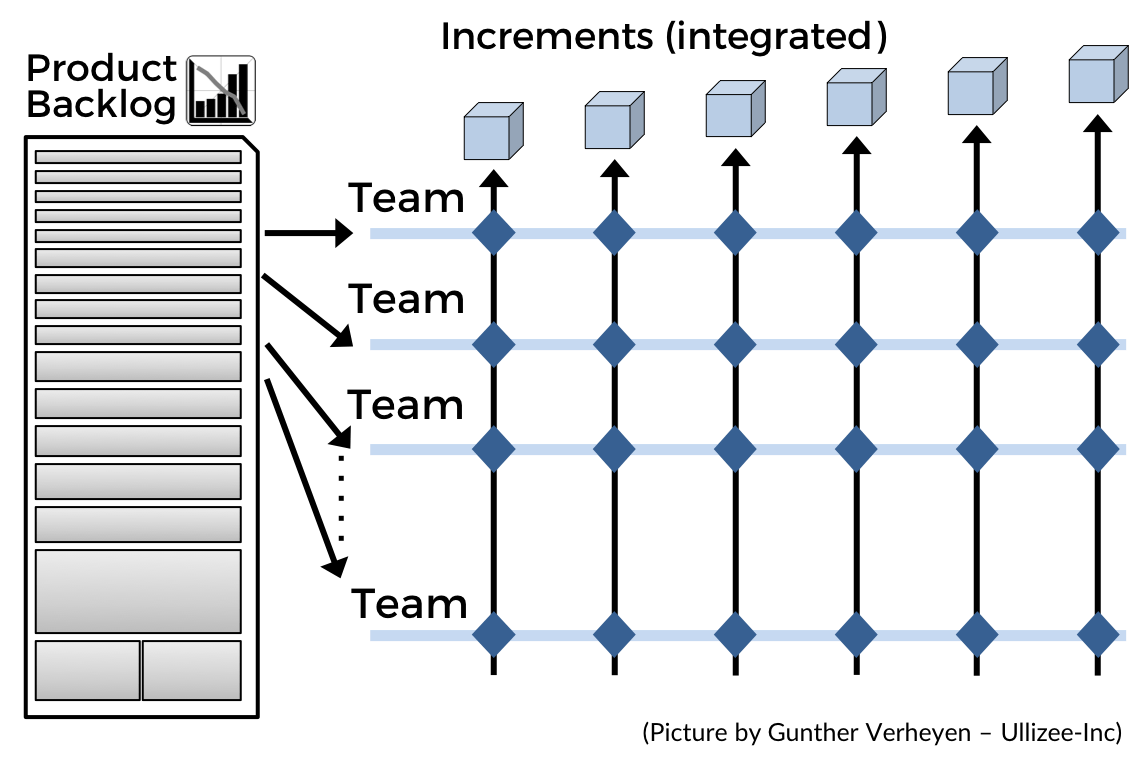
The system called Scrum might consist of multiple teams creating, evolving and maintaining one product. It shouldn’t supersede the minimalism of Scrum. The system works off of one Product Backlog and creates valuable product Increments through the accountabilities foreseen by Scrum.

The context of multiple teams creating one product is often interpreted as an obligation for every team to be a Scrum Team, and every team to be a complete and full-time feature team.

Scrum doesn’t define accountabilities as an excuse to fill positions. Scrum thrives on understanding the accountabilities rather than on blindly filling positions and claiming titles. Scrum doesn’t instruct a uniform, detailed layout of the internals of your system.

Use Scrum to optimise the whole. Optimise your Scrum. Employ Scrum to build a product with multiple teams. Your system is expected to be a feature system, a system capable of producing valuable Increments of product, no later than by the end of a Sprint, regardless the setup of the teams. The accountabilities are expected to be fulfilled, regardless the number of people it takes throughout your system.

Minimally, for n teams working on one and the same product:

  • There are n Development Teams, where the composition of each team is likely to depend on your context. Ultimately, the combined teams need to be able to produce valuable Increments while maintaining the integrity of the product. They self-organise to optimise.
  • There is 1 Product Owner, and most likely a distribution of product ownership. The form of the distribution depends on your context. Ultimately, the flow of product value needs to be unhampered, frequent and targeted.
  • There are 1-n Scrum Master(s), depending on your context. Ultimately, the eco-system and the environment in which it operates need sufficient and sufficiently provocative support, guidance, protection and coaching.

Frameworks like LeSS, Nexus and Scrum@Scale offer diverse strategies at scale that might help in your situation if you are unable to keep your system minimal. Consider your specific needs and opportunities to optimise carefully.

Posted on 3 Comments

Scrum, a forward looking observation (The 3rd Scrum Wave)

All events organised in Scrum are designed to be forward looking. Adaptation follows inspection. Feedback from observable results is meaningless if not applied. All assessments, evaluations and inspections we undertake in Scrum primarily serve the purpose of working on the most valuable future. Scrum inspires us to shift our perspective from solely judging the past and checking actuals towards planning and innovating for an unknown future. In short, focused iterations we reflectively shape the future while embracing unanticipated surprises.

This is the spirit through which we act. We act on forward looking observations. This is the spirit through which we can consider the future of Scrum. Rather than glorifying the past of Scrum, we anticipate the value ahead. We aim at surfing the wave. We shape the wave.

THE 3RD SCRUM WAVE IS RISING. WILL YOU SINK? BARELY SWIM? OR WILL YOU SURF?

‘Agile’ started crossing the chasm as from 2005-2006, much enabled by the increasing popularity of Scrum. The Agile way of Scrum became an accepted way of creating and delivering products. In the subsequent 1st Scrum wave a growing number of teams discovered the first-level benefits of Scrum, albeit predominantly from an IT perspective. Organisations moved away from endless sequential phases and gateways, and began exploring the advantages of iterative-incremental delivery. The 1st Scrum wave was mainly about adopting Scrum, a first encounter, the start of a journey of discovery.

grafx-technology-adoption-life-cycle

In the slipstream of the 1st Scrum wave, sub-groups and derivative movements took off, new movements and methods were invented, introduced, launched, and often disbanded again. Divergence in itself is great, unless the overall result is dilution and opacity. Rather than into variety, the divergence turned into scattering, even with Scrum being the actual standard, even with the definition of Scrum being formalised by its co-creators in 2010 in the Scrum Guide. A bowling alley of problems to be addressed appeared, a wide range of pins. Some pins appeared to be left unaddressed by common Scrum implementations. Some pins were raised to challenge presumed weak spots of Scrum, challenges presented as unaddressable through Scrum. On top of this slow evolution, 2010-2011 saw a seemingly sudden desire of large organisations to transition to this ‘Agile’ thing, fast. The tone for the 2nd Scrum wave was set, a wave of diverging Scrum. Scaling became a thing. Parts of the Scrum terminology became standard vocabulary, but at the same time the tangible rules and principles underlying the Scrum framework were pushed to the back, their purpose snowed in under resurrected needs for layers, titles, roles and structures, at scale.

2016-2017. It takes time to replace the industrial views on the creative act of product delivery. Rat races continue, Scrum is underused as a way out. Too often still the organisational waste, abuse and impediments, ruthlessly highlighted by Scrum, are ignored. Yet, more people and organisations than ever continue their quest to stop more hamster wheels, to create more room to reflect, to improve, to innovate. The 3rd Scrum wave is fuelled by the desire, the drive for rhythm, focus and simplicity. Agile and Scrum are recognised as two inseparable ingredients for healthier and more humane ecosystems that deliver better products. The awareness keeps growing that it starts and ends with people, not with procedures, tools or games. People embrace the Scrum values as a catalyst to re.imagine their Scrum, to re.vers.ify their organisation. Convergence appears on the horizon, where the rage of scattering, where the tornado starts calming down.

We sow seeds. We fertilise the grounds. We help converge product delivery initiatives in a Scrum Studio. We help the shift from traditional to empirical management. We envision a future, networked structure, a nervous system of product hubs and distributed leadership. The 3rd Scrum wave is about enacting Scrum, discovering how the well-defined and clearly stated framework of Scrum leaves plenty of room for variation, a diversity of strategies to employ Scrum.

re-vers-ify-nervous-system-annotated

In 2016 Scrum turned 21. We have come a long way. We look forward. We walk on. We re-vers-ify. We re-imagine our organisations.

THE 3RD SCRUM WAVE IS RISING. WILL YOU SINK? BARELY SWIM? OR WILL YOU SURF?

Posted on Leave a comment

Re.vers.ify (essential introduction)

By the end of 2016, Co-learning organised a webinar about “Re-thinking the organisation”. I feel humbled for sharing my views next to those of the other presenters James Priest (Sociocracy 3.0) and Jürgen De Smet (founder of Co-learning and collaboration architect).

I introduced “re.vers.ify“, the consolidation of over a decade of experience, ideas, beliefs and observations of Scrum. In the recording of my part you will find a fair, 15-minutes summary of my essential and current thoughts and drivers:

Re.vers.ify is an act, an act of simplicity, rhythm and focus. Re.vers.ify is a way for people to re.imagine their Scrum, intentionally emerge a Scrum Studio and -ultimately- re.imagine their organisation.